
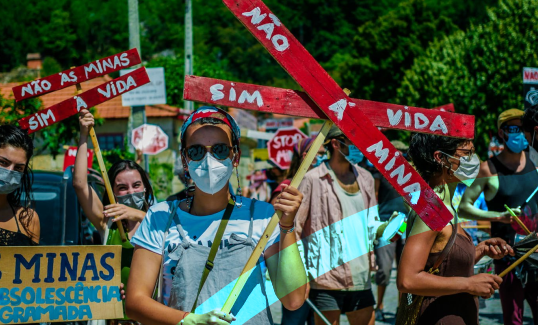
The European Commission is finalising its new laws for raw materials – due March 14. Friends of the Earth Europe joined other European and national NGOs including the WWF, Transport & Environment, Deutsche Umwelthilfe and Ecologistas en Acción in writing to European Commissioners and the Council Presidency to demand strong environmental criteria in these new laws. We want a review of the EU Extractive Waste Directive, which aims to prevent and reduce impacts of mining waste on the environment and on human health, and sets clear, ambitious and binding recycling targets.
To:
Ursula von der Leyen, President of the European Commission
Frans Timmermans, Executive Vice-President of the European Commission
Margrethe Vestager, Executive Vice-President and European Commissioner for Competition
Valdis Dombrovskis, Executive Vice-President and European Commissioner for Trade
Thierry Breton, European Commissioner for the Internal Market
Virginijus Sinkevi?ius, European Commissioner for Environment
The Swedish Presidency of the Council of the European Union
CC:
Member State Ambassadors to the Council of the European Union
Hildegard Bentele, Member of the European Parliament
Mohammed Chahim, Member of the European Parliament
Pascal Canfin, Member of the European Parliament
Bas Eickhout, Member of the European Parliament
Brussels, 8th February 2023
Honourable European decision-makers,
Combating climate change is a race against the clock but it is a race we can win. Transitioning to renewable energy, efficient buildings and clean, appropriately sized vehicles rapidly and at an unprecedented scale is a precondition if we are to limit global warming to 1.5°C. Europe’s reliance on fossil fuels also undermines our energy security and only highlights the urgency with which we must phase out their use.
The energy transition will require both a tremendous technological shift and a systematic change in our behaviour and structures. Technologies from wind turbines to solar panels and batteries will require an increased supply of responsibly sourced critical minerals such as copper, silicon metal, lithium and rare earths.
But sourcing these minerals must not replace one bad dependency (extracting fossil fuels) with another. While global markets are crucial for scale, innovation and collaboration, Europe should not be naive. We must strengthen our industrial capability to sustainably source, refine, process and recycle these key materials. On the other hand, our products policy should incentivise demand reduction, reuse and sustainable substitution for scarce critical metals. This should be done while cutting inefficient use and maximising the benefits of circularity.We must also not repeat the mistakes associated with unsustainable, unethical and opaque mining practices. Without strong and binding safeguards, the energy transition risks exacerbating mining related issues such as excluding impacted communities and regions from its benefits.
This is why the upcoming Critical Raw Materials Act is key. As a baseline, any project benefitting from EU support, including faster permitting or finance, must meet the highest environmental, social, and human rights standards. In addition, three things are needed to ensure the Act upholds circularity, climate and environmental protection principles. The undersigned organisations call on policymakers to:
? Uphold legal frameworks such as the Water Framework Directive, the Habitats Directive and the REACH Regulation. While we support and understand the drive to accelerate the critical metals value chain in Europe, it should not come at the expense of weakening the EU environmental acquis or disregarding the voice of local communities. In addition, the EU should urgently review the Extractive Waste Directive including improving tailings management and mapping legacy mining waste sites to incentivise re-mining processes.
? Set clear and ambitious secondary raw material targets for Europe’s raw materials self-sufficiency. From scaling up recycling capacities to expediting Europe’s potential in urban mining, the EU must prioritise critical metals coming from secondary sources, such as from old mining sites. The End-of-Life Vehicle Directive is an additional instrument in this regard, and should require critical metals in vehicles (e.g. rare earth elements in conventional exhaust treatment systems or electric car motors) to be fully recovered. EU product legislation should consistently require binding recycled content targets, as the EU Battery regulation has done.
? Ensure that the act requires the measuring of carbon footprints and broader environmental impacts for imported and domestic metals. This will ensure that there is
transparency as to the origin and impact of these raw materials, help downstream companies make better decisions, and set the basis for future emission reducing
policies. The Ecodesign framework should require such measurements for all products containing critical metals in the future.
The Critical Raw Materials Act, if done right, can secure a resilient and sustainable supply of critical metals. Responsible and sustainable sourcing must be a precondition for a social licence to operate in Europe together with measures addressing circularity and recovery of metals.
We hope you consider these recommendations in your legislative deliberations, and remain at your disposal for any further information.
Yours sincerely,