
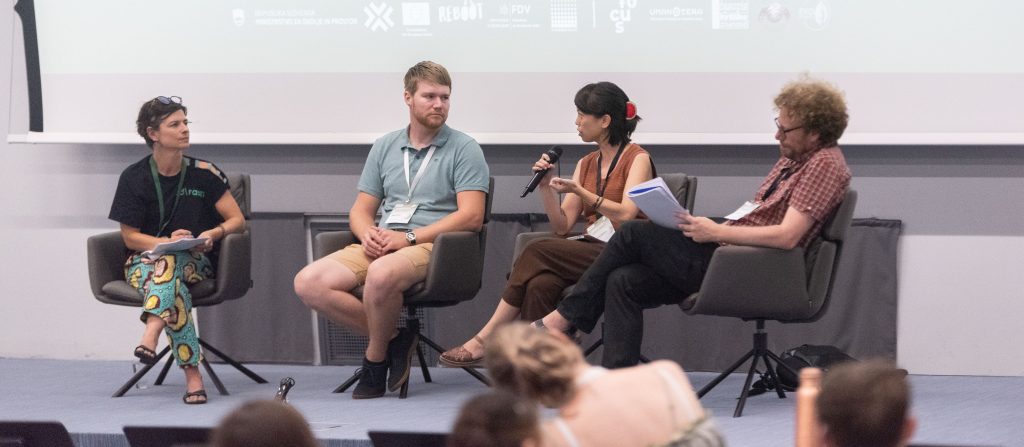
We participated in a round-table as part of the summer school organised by Focus (FoE Slovenia), with the title “POLITICAL ECOLOGY OF SELF-SUFFICIENCY: between Eco-nationalism and Just Transition”. The round-table focused on the sustainable transition of the agri-food system, bringing together natural science and social science perspectives and raising questions about what kind of food system we need and how to get there.
What’s our vision?
As part of the Nyeleni movement, FoEE is a proponent of food sovereignty: the right of populations to healthy and culturally appropriate food, produced using ecologically sustainable methods. Food sovereignty puts the people who produce, distribute, and consume food at the heart of food policies and systems, instead of the profits of the markets and multinationals.
How does this relate to degrowth?
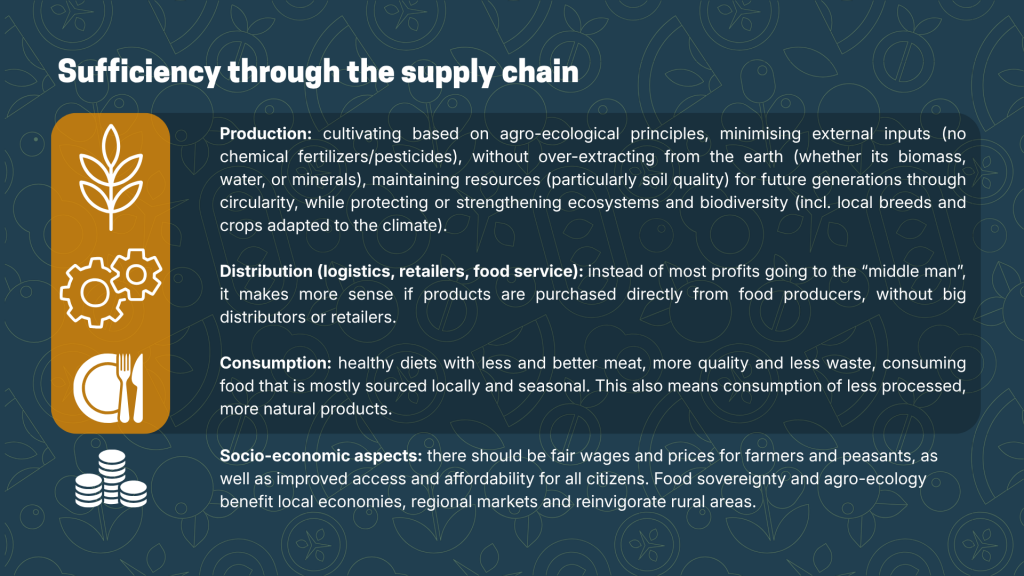
To achieve an economy beyond growth, our food system has to be redesigned around the concept of sufficiency: meeting human needs without exceeding planetary boundaries. This requires transformation of production, distribution and consumption based on agro-ecological principles and socio-economic justice:
So how does this relate to self-sufficiency?
As we discussed at the round-table, self-sufficiency is a narrower interpretation of food sovereignty, implying that countries, or regions, should produce mostly for themselves, limiting (unsustainable) export and import of non-essential goods. However, the problem is not trade itself, but how it is done (through unfair trade agreements) and the overproduction of certain products for the world market only benefiting private corporations.
We need to ask ourselves, does it make sense that the Netherlands produces so much surplus milk and cheese for the world market at the cost of its soils and ecosystems? Does it make sense that the price of bread skyrocketed due to the invasion of Ukraine, because countries do not produce enough wheat themselves? Self-sufficiency is not the answer, but a re-territorialisation of food supply chains is indeed necessary.
The overall goal should be: producing enough, not producing too much and achieving resilience instead of maximum profits.
What can we do?
We need to end harmful subsidies for polluting agro-industry and reallocate them to peasants and agro-ecological farmers to ensure fair prices. Essentially, a just transition is only possible by addressing the power structures and corporate capture of the sector. We need a deep democratization and re-localization of food systems, to challenge the capitalist control and financialization of the food system. Small-scale farmers and peasants should be the protagonists of political change, taking back power from agro-industrial corporations through agrarian reform. This means repealing the WTO Agreement on Agriculture, adopting a new framework for international agricultural trade and ultimately achieving food sovereignty.
As for direct action: access to adequate, safe, sustainable and nutritious food is a fundamental human right. That is why FoEE supports the European Citizens Initiative on the Right to Food. We only have until January to gather 1 million signatures, add yours now!