
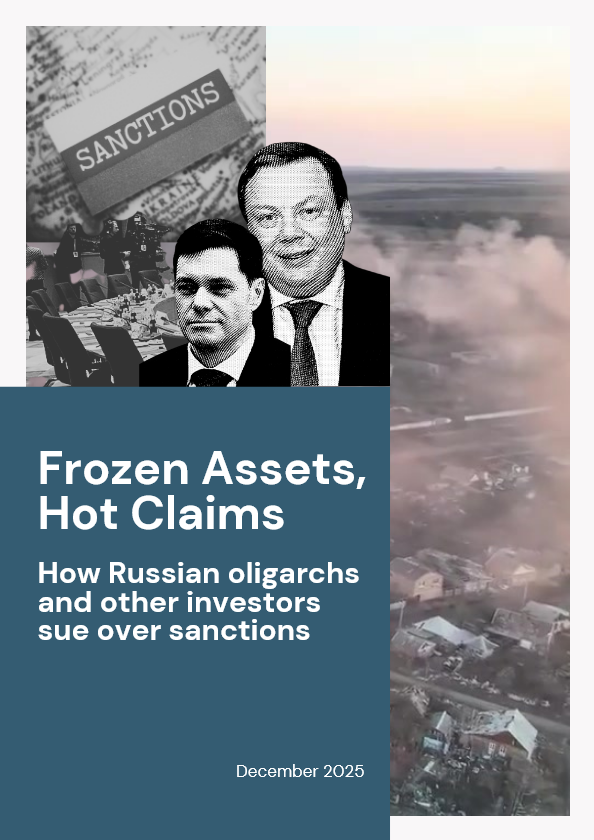
After Russia’s full scale invasion of Ukraine, the EU, Ukraine itself and almost 20 other countries introduced wide-ranging economic sanctions against the Russian state. The sanctions also target companies and individuals closely linked to the regime and the war effort.
These sanctions are now being challenged by Russian oligarchs and companies in private tribunals using a mechanism written into investment treaties, known as investor-state dispute settlement (ISDS). While the cases are in early stages, they are already having a severe impact on EU sanction policy and Ukrainian national security policy.
Our analysis reveals that 24 publicly known ISDS cases have been initiated directly challenging sanctions against Russia, out of a total of 28 sanctions-related cases and threats. The cases challenging sanctions include:
- The sanctioned Russian oligarch Mikhail Fridman is suing Luxembourg for 16 billion USD for freezing his assets;
- Several Russian investors are initiating claims against Belgium over the freezing of Russian-held assets at Euroclear;
- Investors are suing Ukraine in two separate cases over the removal of a Russian-linked bank from Ukraine’s banking sector, for a combined amount of 1.4 billion USD.
Our analysis also shows that:
- Overall, known ISDS claims and threats of claims by sanctioned individuals and entities already amount to 62 billion USD. This is getting close to the 70 billion USD of military assistance the EU has provided to Ukraine since 2022.
- More than half of the ongoing, sanctions-related ISDS cases are against Ukraine.
- Russian oligarch Mikhail Fridman has filed five claims against sanctions-related measures and threatened a sixth case. Three of the five cases are targeting Ukraine, of which two are based on the investment treaty that Ukraine has with Belgium and Luxembourg and the other on one with the Netherlands.
- Of the 24 cases challenging sanctions, 13 have been initiated in 2025 alone, highlighting how investors are increasingly resorting to ISDS to challenge the sanctions policy of Ukraine and its supporters.
The incompatibility of EU countries’ investment treaties with EU sanctions policy was previously highlighted by the European Court of Justice in 2009. However in the years since then, the countries and other EU Member States with similar clauses in their treaties have failed to act. They have not renegotiated their treaties to include safeguards, nor have they cancelled them.
In view of the increasing weaponisation of investment treaties to weaken the European and Ukrainian sanctions policy, it is paramount that the EU and Ukraine adopt effective measures to neutralize ISDS risks.