
The European Commission is on a roll. After proposing to destroy Europe’s corporate sustainability law, they now want to attack various food laws, including on protections from pesticides.
Stripping away protection against toxic pesticides
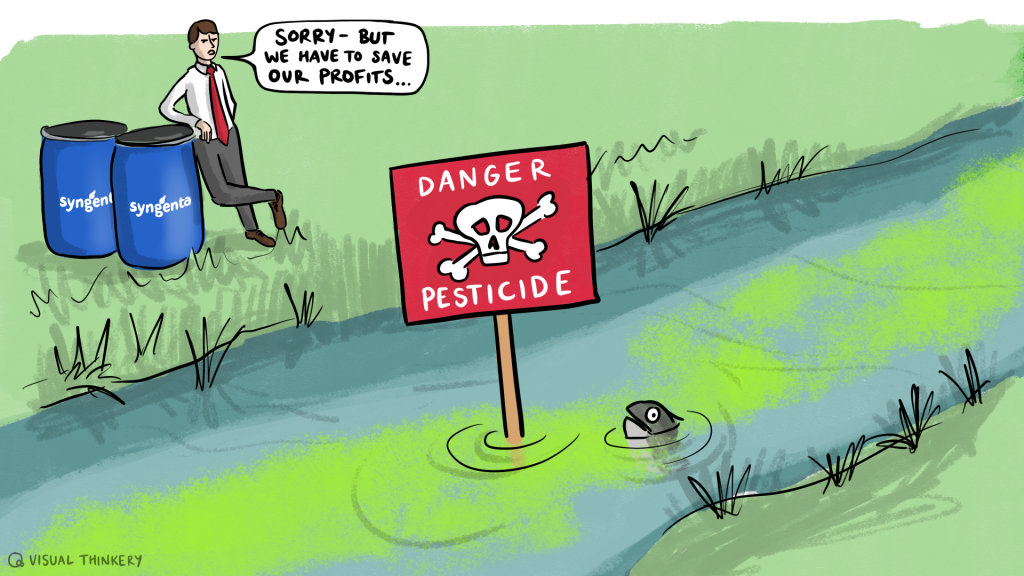
The European Commission is pushing a sweeping overhaul of pesticide rules that could dramatically weaken protections for people and the environment. The proposal published on December 16th would dismantle the system that keeps these harmful chemicals out of our food, water, and ecosystems. These changes are part of a broader effort to bow to the demands of agribusiness, prioritizing short-term profits over public health and environmental safety.
Trampling on democratic rules, the Commission has conducted neither an impact assessment nor a public consultation, both of which would normally be required for a proposal of this kind.
What’s in the works?
The European Commission is planning no less than lifetime approval for pesticides. That means no more mandatory regular re-evaluations! Many pesticides would no longer need to be reassessed every 10 to 15 years to take into account new scientific studies on their safety, and they could remain approved indefinitely. Although exemptions are foreseen, the proposal makes unlimited approval the default rather than the exception, fundamentally undermining the precautionary principle. In addition, the lack of clarity regarding exemptions and vague wording creates a significant risk of arbitrary interpretation.
The new rules would also limit EU member country’s ability to act on new evidence. Even when studies reveal serious health or environmental risks, national authorities could not take action without first requesting a Commission-led reassessment. This would effectively prevent member countries from incorporating new peer-reviewed studies or other evidence. Under such a system, Denmark, for example, would not have been able to ban PFAS pesticides, as it did recently.
As if it weren’t enough, the Commission allows for the doubling the period during which highly toxic pesticides can still be sold after being banned to protect our health or the environment. Instead of 1.5 years, citizens could be exposed to these chemicals for up to 3 years.
Other concerning parts of the proposal include broader exemptions that could make it easier to approve pesticides, a problematic definition of biocontrol products that extends beyond natural substances, and allowing more extensive use of drones to spray chemicals.
These changes are a big attack on Europe’s chemical safeguards at a time when science, public concern, and the health and biodiversity crises call for stronger, not weaker, protections.

What does it mean for our food and the environment?
Regular re-evaluations of pesticides are the only times when chemical companies are required to fully update safety information, take new scientific evidence into account, and prove that their products still comply with EU standards.
If these reviews were removed, it would have wide-ranging and serious consequences:
Dangerous pesticides left unchecked
Many pesticides may seem safe during initial testing, but later turn out to harm people and the Many pesticides may seem safe during initial testing, but later turn out to harm people and the environment. The EU’s system for re-evaluating pesticides has repeatedly uncovered serious harms years after a pesticide was first approved.. Without these reviews, dangerous chemicals could stay on the market indefinitely.
For example:
- Chlorpyrifos. It has been used for decades without anyone recognizing its harmful effects on children’s brain development. Only after new research emerged did the EU finally ban it in 2020.
- Mancozeb. It stayed legal for more than 50 years, as early evaluations missed its risks to hormones, reproduction, and the nervous system. These dangers were confirmed through later scientific studies, leading to a ban in 2021.
- Flufenacet. Allowed for over 20 years, new safety data revealed it disrupts hormones in humans and wildlife and breaks down into a persistent chemical called TFA (trifluoroacetic acid), which now shows up in tap water across Europe. This led to a ban in 2024.
These examples show why regular pesticide re-evaluations are essential: they are the only way to catch long-term harms that weren’t known when a product was first approved.Take Glyphosate for example, linked to potential cancer risks and widely criticized by independent scientists and public health advocates. Or Acetamiprid, the last widely approved neonicotinoid in the EU linked to developmental brain harm. Under the new rules proposed by the Commission, these pesticides (and many others) could remain on the market indefinitely, even as new evidence continues to raise serious concerns. According to an analysis by the French NGO Générations Futures, 49 synthetic substances would receive unlimited approval if the Commission’s proposal was to enter into force.
A race to the bottom
If older pesticides are no longer required to undergo mandatory re-evaluation, keeping them on the market becomes cheaper than developing safer alternatives. Rather than promoting safer innovations or encouraging farmers to work with nature to manage pests, weeds, and plant diseases, the proposal risks trapping them in continued reliance on harmful chemical products.
The industry’s wishlist
The measures proposed in the Omnibus clearly reflect long-standing industry demands.
Bayer, one of Europe’s largest pesticide producers, openly called for ending mandatory full-dossier reviews when pesticides are renewed. The company suggested that approvals should become “unlimited with periodic literature reviews or safety updates where needed,” arguing this would “free regulatory capacity for novel product assessments and reduce unnecessary administrative burden.” The Commission is using the exact same reasoning to justify the Omnibus reforms. Similarly, CropLife Europe, which represents major pesticide companies, called for replacing resource-intensive re-submissions with a system that only reviews genuinely new information.
Many other industry requests, such as easier approval of drone spraying, broader exemptions for pesticide use, and longer grace periods for banned products, are also included in the Omnibus. This shows how closely the proposal mirrors the pesticide industry’s agenda, prioritising their wishes over public health, biodiversity, and safety.

Who pays the price of this deliberate destruction of laws?
The Commission’s political case rests on a headline figure of over €1 billion in annual savings. These estimates rely on outdated studies – some dating back to 2007 – and overly optimistic assumptions. Crucially, the Commission does not attempt to balance these claimed savings against potential healthcare costs and environmental damage.
Evidence shows that the societal costs of pesticide use far outweigh the industry’s economic benefits. A study by le BASIC estimated that, in Europe alone, the costs directly attributable to pesticides and borne by society reached €2.3 billion in 2017, more than twice the €0.9 billion in net profits generated by the pesticide industry that same year. At the global level, a recent report by Systemiq estimates that pesticides and other toxic chemicals cause US $3 trillion in preventable health and environmental costs every year, including US $1.4–2.2 trillion in healthcare expenditure and US $640 billion in ecological damage.
By making indefinite approval the default, the Food Omnibus proposal shifts responsibility for pesticide safety away from companies and onto the public. Today, companies must regularly prove that their pesticides are still safe by submitting updated scientific data. If they fail to do so, approval can be withdrawn. Under the proposed changes, this responsibility would shift to public authorities, who would have to prove that a pesticide is dangerous before acting. This puts the cost and burden of monitoring on taxpayers, delays action until harm has already occurred, and allows companies to keep selling their products and making profits, while the risks are borne by people and the environment.
How would scaling back pesticide protections affect the health of farmers and nearby communities?
Farmers and farm workers are often the first victims of pesticide use, with many developing cancers, neurological diseases like Parkinson’s, and other serious health problems linked to chemical exposure. Even when they use protective equipment, studies show they remain at risk.
It’s not only farmers who are affected: families and neighbours are exposed to drifting chemicals, making pesticide use a wider community health issue. Many farmers are reluctant to speak out, and the dangers of pesticides remain a largely taboo topic.
Allowing toxic pesticides to remain on the market unchecked will put farmers and rural communities at serious risk, threatening their health and wellbeing.
Can we still trust that drinking water is safe?
Pesticides are widespread in European water. Surveys show that 22% of rivers and lakes have levels above safety thresholds, and studies in countries like the Netherlands, Denmark, and Ireland found pesticides in drinking water exceeding safety limits. While this clearly calls for stronger safeguards to protect our water and environment, the Commission is instead proposing to weaken existing protections.
A rearguard move that puts agribusiness profits before our future
The harms of pesticides are well known: they wipe out pollinators like bees and butterflies, which are essential for our food; they contribute to rising chronic diseases such as cancer and Parkinson’s; and farmers and rural communities face the highest exposure and greatest health risks.
If the worrying proposal in the pipeline goes ahead, it will be a slap in the face to the more than 1.1 million citizens across Europe who called on the EU to end pesticide use. They expect the EU to protect their health, not prioritize industry profits over their safety.