
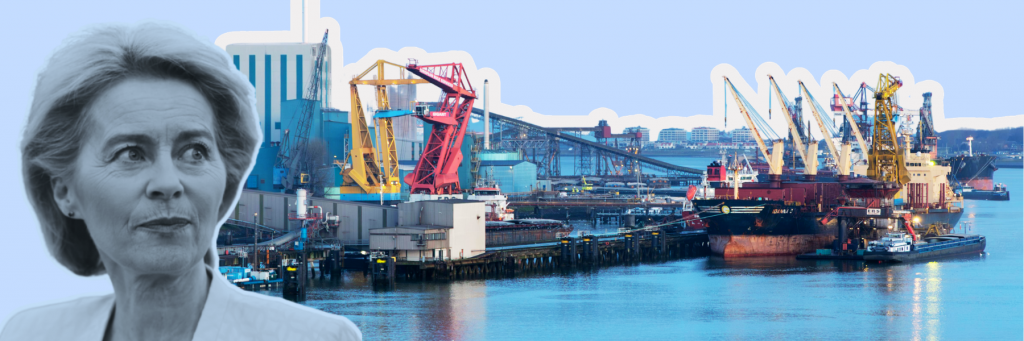
Today in Antwerp, President von der Leyen sat down with hundreds of corporate representatives from Europe’s chemical industry just hours before meeting EU heads of state – a choreography that exposes a deep crisis of democratic priorities in the European Union. In a joint declaration initiated by, among others, Friends of the Earth Europe, Corporate Europe Observatory, The Good Lobby and Transparency International EU, the organisations denounce this ‘recurring pattern’ of privileged access for corporate interests.
This is not an isolated meeting, but part of a wider pattern in this second von der Leyen Commission, where “the economy” has become the catch‑all justification for weakening democratic safeguards and rolling back environmental and social protections. Since 2024, the Antwerp Declaration has operated as a shadow roadmap for EU policy, used to legitimise a deregulatory agenda driven by corporate demands rather than public interest.
The numbers tell a stark story. Forty percent of meetings held by Commissioners’ cabinet members are with company representatives, another 29% with business associations, while only 16% are with NGOs. This imbalance is a structural invitation to policy capture. On top of this, new forums such as “Reality Check Workshops” and “Implementation Dialogues” have been created in opaque ways. These concerns translate directly into decisions that make people’s lives more precarious and Europe’s crises harder to solve.
Consider the surge in “omnibus” legislative packages – these packages weaken multiple protections at once, often without proper impact assessments, scientific justification or meaningful consultation. The European Ombudswoman has already raised concerns about the Commission’s failure to follow its own better‑regulation rules; instead of correcting course, the Commission chose to weaken those safeguards further.
The consequences are not difficult to predict. People across Europe are increasingly exposed to “forever chemicals” such as PFAS, pesticide pollution and more frequent extreme weather, with huge economic and wellbeing costs. Families should not have to worry about toxic substances in their drinking water, food or children’s playgrounds, yet deregulation of pesticides and chemicals pushes us in exactly that direction. Rules that guarantee clean air, safe workplaces, data protection and guardrails on risky AI are being treated as expendable obstacles to profit rather than basic conditions for a dignified life.
Meanwhile, industry lobbying has unlocked billions in public subsidies, justified by claims of crisis and capital shortages that often fall apart under scrutiny. From 2010 to 2023, European firms in key energy‑transition sectors generated enormous net profits and channelled the lion’s share – more than 75% – to shareholders, instead of investing in a just and sustainable transition.
This trajectory risks locking in a race to the bottom, where the most harmful industries win weaker rules and more subsidies, while citizens face eroded protections and austerity. Europe’s industrial strategy could instead prioritise investment in a toxic‑free, decarbonised and fair economy, ensuring that companies, not communities, bear the costs of the damage they cause.
What is needed is a new spirit of law‑making, grounded in evidence, democratic participation and the voices of those most affected. Civil society, trade unions, environmental groups, scientists and independent experts must truly help shape decisions, so EU rules serve the public interest, not the wish‑lists of polluting sectors.
Today’s meeting in Antwerp throws this choice into stark relief: European leaders must abandon closed‑door deals with those driving pollution and social harm, and the laws that shape Europe’s future must be made transparently, with and for its people. When Europe’s chemical lobby gets a private audiencewith President von der Leyen hours before the EU heads of state meet in a fancy castle in rural Belgium, citizens are right to ask who is being served by EU policy, because Europe’s future must be shaped by 450 million people, not a handful of powerful corporate lobbies.
Kim Claes, corporate capture campaigner at Friends of the Earth Europe.

We think you’d also like:

Fossil Free Politics
Politicians should make climate laws to protect people – not please the fossil fuel industry. We need to cut fossil fuel interests out of our politics, similar to existing restrictions on the tobacco industry.