
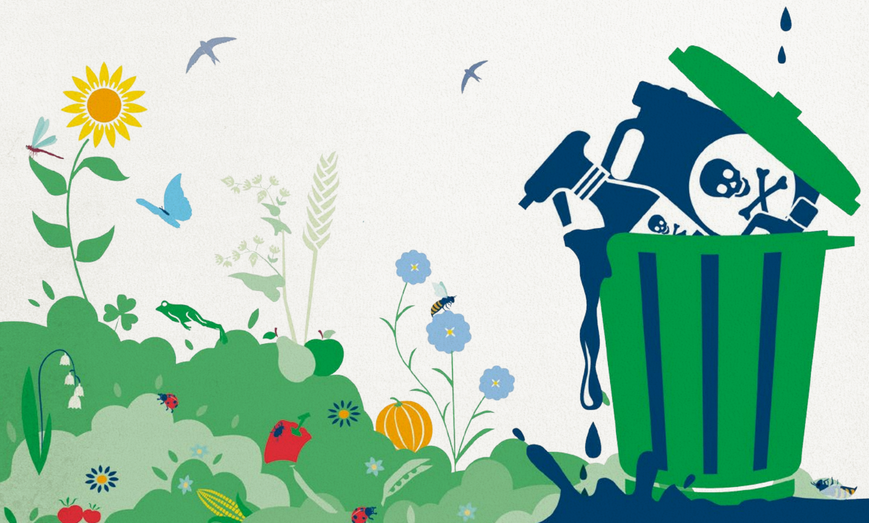
Today, on World Food Day, PAN Europe and Friends of the Earth Europe publish a new report, showcasing farmers and municipalities successfully eliminating or minimising pesticide use. The impressive and inspiring work of these farmers, and many others, should encourage policy-makers to support and ensure the wide uptake of ecologically sound practices and the phase out of harmful pesticides.
At a time when the European Commission appears increasingly focused on backtracking on urgently needed environmental and sustainability objectives, illustrated by deregulation and lack of vision of the CAP post-2027 proposal, these examples show that producing food and managing public spaces without harmful pesticides is possible, and already happening throughout Europe.
The report zooms in on six farmers and two cities across Europe, all managing to, each within their own specific systems, minimise or completely phase out pesticide use. While the systems are diverse, common ingredients include focus on restoration of soil life, diversity and ecosystem functioning, to actively prevent vulnerability to pests and increase overall resilience.
Clara Bourgin, food, farming and nature campaigner at Friends of the Earth Europe, said:
“While EU policymakers move backwards, people on the ground show that farming without harmful pesticides is actually possible. It’s time for the European Commission to support the transition to a healthier, fairer, more sustainable food system instead of undermining it“
There is no time for backtracking. Pesticides pollute our soils, water and air. Biodiversity has been crashing at an alarming rate, with pesticides being a main cause [1]. Just a few days ago, the International Union for Conservation of Nature (IUCN) revealed that more than a fifth of Europe’s bumblebee species and one in 10 of its wild bee species overall risk extinction [2]. These pollinators are essential for healthy ecosystems and food production, yet their populations are collapsing. Meanwhile, harmful chemicals continue to poison citizens, particularly farmers, farm workers and rural communities, suffering both acute and long-term health impacts [3].
The report highlights that these harms are avoidable – future-proof, ecologically sound farming methods make it possible to protect biodiversity, human health, and food production simultaneously.
Kristine De Schamphelaere, policy officer for agriculture at PAN Europe, said:
“Healthy, future-proof food production is rooted in living soils and overall ecosystem health. A ‘yes we can’ mentality is needed, opposite to the misleading narrative that heavy use of toxic chemicals is needed to produce food,”
The report also zooms in on Paris and Zagreb, 2 of the cities across Europe which prioritise biodiverse, healthy public spaces, without the use of harmful pesticides.
Natalija Svrtan, campaigner for Pesticide Free Towns at PAN Europe, said:
“Paris and Zagreb prove that cities thrive without pesticides. By embracing nature-based maintenance, they have created cleaner, safer, and more vibrant urban spaces for their citizens. It is time for all EU countries to follow their lead and make pesticide-free towns the standard,”
The report urges policymakers to properly enforce existing laws and provide the supportive framework needed to phase out toxic pesticides. Although Integrated Pest Management (IPM) is required under the Sustainable Use of Pesticides Directive (SUD), it remains very poorly implemented in Member States. High-expert independent advisory systems on IPM and peer-to-peer learning should foster its wide implementation. The Common Agricultural Policy should be transformed to truly support fair, environmentally sustainable farming and the transition out of pesticides.
With special thanks to farmers Felix de Bousies (Belgium), Sheila Darmos (Greece), Jean-Bernard Lozier (France), Esther Molina (Spain), Mátyás Bekecs (Hungary) and Aleksandar Sotirov (Bulgaria).
Read the full report here.
Notes
[1] Factsheet on the impact of pesticides on biodiversity(link is external), Hallmann et al. (2017). More than 75 percent decline over 27 years in total flying insect biomass in protected areas,(link is external) Wan et al. (2025). Pesticides have negative effects on non-target organisms(link is external), Seibold et al. (2019). Arthropod decline in grasslands and forests is associated with landscape-level drivers(link is external), Brühl et al. (2024). Widespread contamination of soils and vegetation with current use pesticide residues along altitudinal gradients in a European Alpine valley(link is external), EEA (2023). How pesticides impact human health and ecosystems in Europe(link is external), Brühl et al. (2021). Direct pesticide exposure of insects in nature conservation areas in Germany(link is external), Honert et al. (2025). Exposure of insects to current use pesticide residues in soil and vegetation along spatial and temporal distribution in agricultural sites(link is external), Mauser et al. (2025). Current-use pesticides in vegetation, topsoil and water reveal contaminated landscapes of the Upper Rhine Valley, Germany(link is external), Rigal et al. (2023). Farmland practices are driving bird population decline across Europe(link is external), Beaumelle et al. (2023). Pesticide effects on soil fauna communities – A meta-analysis(link is external), Gunstone et al. (2021). Pesticides and Soil Invertebrates: A Hazard Assessment(link is external)
[2] The Guardian (11 Oct 2025): Number of wild bee species at risk of extinction in Europe doubles in 10 years(link is external)
[3] Factsheet on the impact of pesticides on people’s health(link is external), Inserm (2021). Collective Expert Review on the Health Effects of Pesticides(link is external), EEA, 2023: How pesticides impact human health and ecosystems in Europe(link is external), Silva et al. (2023). Pesticide residues with hazard classifications relevant to non-target species including humans are omnipresent in the environment and farmer residences(link is external), Alaoui (2024). Identifying pesticides of high concern for ecosystem, plant, animal, and human health: A comprehensive field study across Europe and Argentina(link is external)