
The Netherlands and Portugal join four other EU countries facing such an infringement complaint, as the Global Days of Action against Investor-State Dispute Settlement (ISDS) begin.
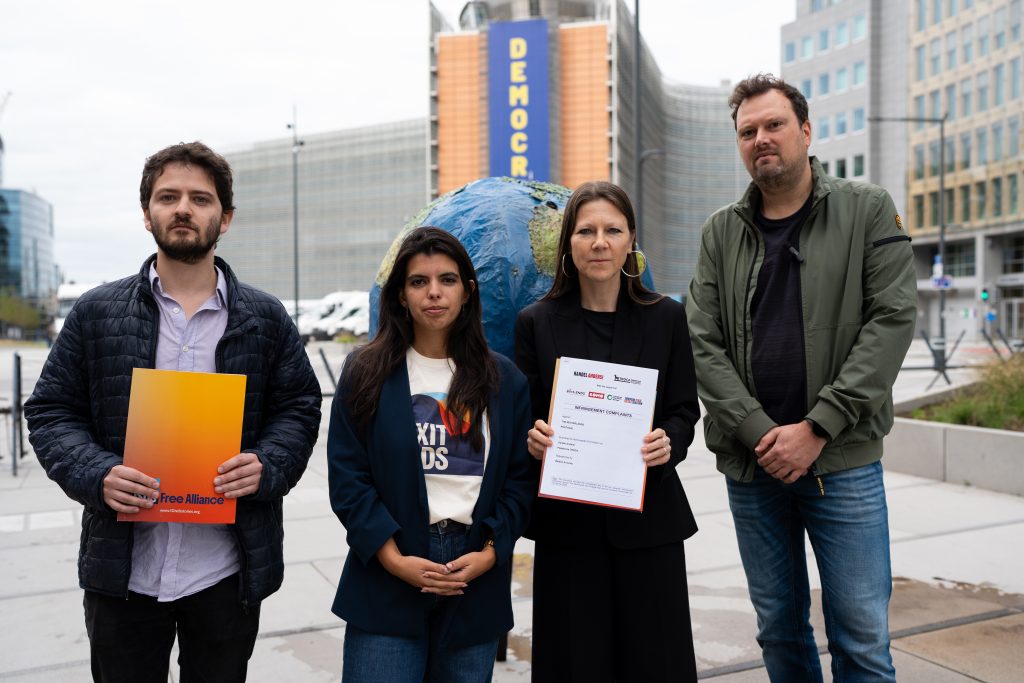
Dutch and Portuguese trade justice groups Handel Anders! and TROCA, supported by Friends of the Earth Europe, today asked the European Commission to start legal proceedings against both countries over their bilateral investment treaties (BITs) with non-EU countries. Handel Anders! and TROCA will hand in the complaint in person in Brussels, on behalf of a group of organisations that also includes Both ENDS and SOMO. They are arguing that these treaties breach EU law, and put at risk both governments’ ability to act in the public interest, including to protect people, the environment, the climate and to enforce sanctions. Similar complaints were filed in December 2025 against Germany, France, Austria and Sweden.
The complaint makes two arguments. Most Dutch and Portuguese BITs, especially those signed before 2009, fail to prevent interferences with EU law when foreign investors sue the state through ISDS. Their capital transfer clauses allow sanctioned businessmen to claim compensation for EU sanctions – a conflict the EU Court of Justice already identified in 2009. Since then, the Netherlands and Portugal have neither renegotiated nor terminated these treaties.
Between 2022 and 2025, Shell and ExxonMobil filed multiple arbitration cases against the Netherlands over the closure of the Groningen gas field, while contesting their financial liability for decades of earthquake damage. Since 2025, Omani energy company Petrogas has been using the Netherlands-Oman BIT to challenge the temporary solidarity contribution on windfall profits in the oil and gas sector, which the Netherlands introduced in 2022 to implement an EU regulation, as well as temporary increases in gas royalties. The levy was designed to ensure that energy companies paid their fair share towards public budgets and society during a period of exceptional profits and social hardship.
In July 2026 it emerged that Mikhail Fridman, a sanctioned Russian billionaire with investments in Holland & Barrett, is using the 1989 Netherlands-Russia BIT to sue the Netherlands over sanctions imposed after Russia’s invasion of Ukraine. Sanctioned investors are bringing similar claims elsewhere in Europe, including against Luxembourg.
The ISDS system poses a long-term financial burden on EU countries. It has already cost EU taxpayers 12 billion U.S. dollars, public money that should be going to healthcare and housing among other things.
Linda Fokkema, coordinator of Handel Anders! said:
“These treaties enable multinational corporations to sue governments with billion euro claims over policies meant to protect people, the environment and the climate. The Netherlands is experiencing this first-hand, with Shell and ExxonMobil pursuing claims over the closure of the Groningen gas field. Yet the Netherlands continues to maintain these treaties that expose countries all over the world to these risks. It is time that governments end this system and we hope our complaint at the European Commission finally sets us in that direction”.
Eduardo Proença, campaigner at TROCA said:
“The Portuguese Government has already recognised the extremely serious structural problems with ISDS, denouncing the Energy Charter Treaty in 2024. However, 34 BITs containing ISDS clauses remain in force. Today, Portugal is in a unique position to terminate these clauses. It has just won the first known ISDS case against the Portuguese State, but paid for that victory with nearly four years of legal proceedings and over 1.6 million euros in external legal fees. Even in victory, the impact is always one of exorbitant costs for the State and no benefit whatsoever.”
Frances Verkamp, trade and investment campaigner at Friends of the Earth Europe said:
“Brussels has spent the last four years talking tough on democracy, sanctions against aggressors and strategic autonomy, but is still letting foreign investors challenge the very decisions and policies that are critical for our well-being and security. This wave of infringement complaints must be a wake-up call for the European Commission to finally end such illegitimate investor privileges.”
The group calls on the Netherlands and Portugal to terminate their investment treaties or bring them in line with EU law, removing ISDS and the capital transfer clauses that undermine EU sanctions. Withdrawing from ISDS would mirror previous action by over 10 member-states and the EU itself, which recently exited the Energy Charter Treaty (ECT) over concerns about this mechanism. The European Commission must now decide whether and how to take the complaint forward.
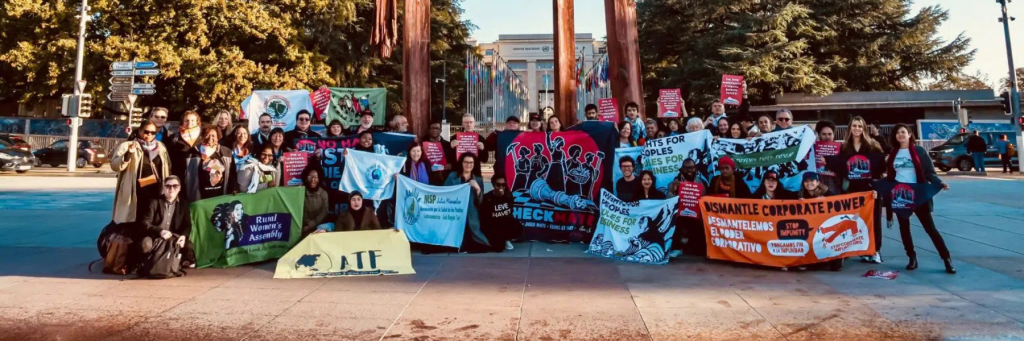
The complaint is part of a growing global call to reform trade and investment agreements that give investors disproportionate rights. ISDS was already a central theme at the recent conference on Transitioning Away from Fossil Fuels (TAFF) in April in Colombia. From 15 October, anyone can support the call by signing the online petition.
Notes
- The complaint argues that the Netherlands breaches its duty of sincere cooperation (Art. 4(3) TEU) and asks the Commission to act under Art. 258 TFEU. Only the Commission can open an infringement procedure and it is not obliged to do so; it will now assess the complaint.
- 2009 rulings: in Commission v Austria (C-205/06), Commission v Sweden (C-249/06) and Commission v Finland (C-118/07), the EU Court of Justice found that capital transfer clauses in investment treaties conflict with the Council’s power to impose sanctions.
- Background: Frozen Assets, Hot Claims (December 2025) maps ISDS claims by sanctioned investors. Phasing out ISDS in the Netherlands: a roadmap sets out how the Netherlands can exit. https://europeantradejustice.org/european-isds-scorecard-2026/ ranks the harmful effects of 30 countries’ investment treaties https://www.somo.nl/aftershock-in-groningen/ describes how Shell and ExxonMobil use arbitration to offload the costs of closing the Groningen gas field in the Netherlands.
- The complaint and petition are part of the Global Days of Action against ISDS, 15-17 October 2026: https://stopisds.global/en/
About Handel Anders!
Handel Anders! is a Dutch coalition of civil society organisations, including environmental and human rights organisations, research organisations, trade unions and farmers’ groups, that calls for sustainable and just trade.
About TROCA
A non-partisan, civil society, volunteer-led group in Portugal dedicated to fostering fair international trade, which currently focuses its campaigning on the fight against the ISDS mechanism.