
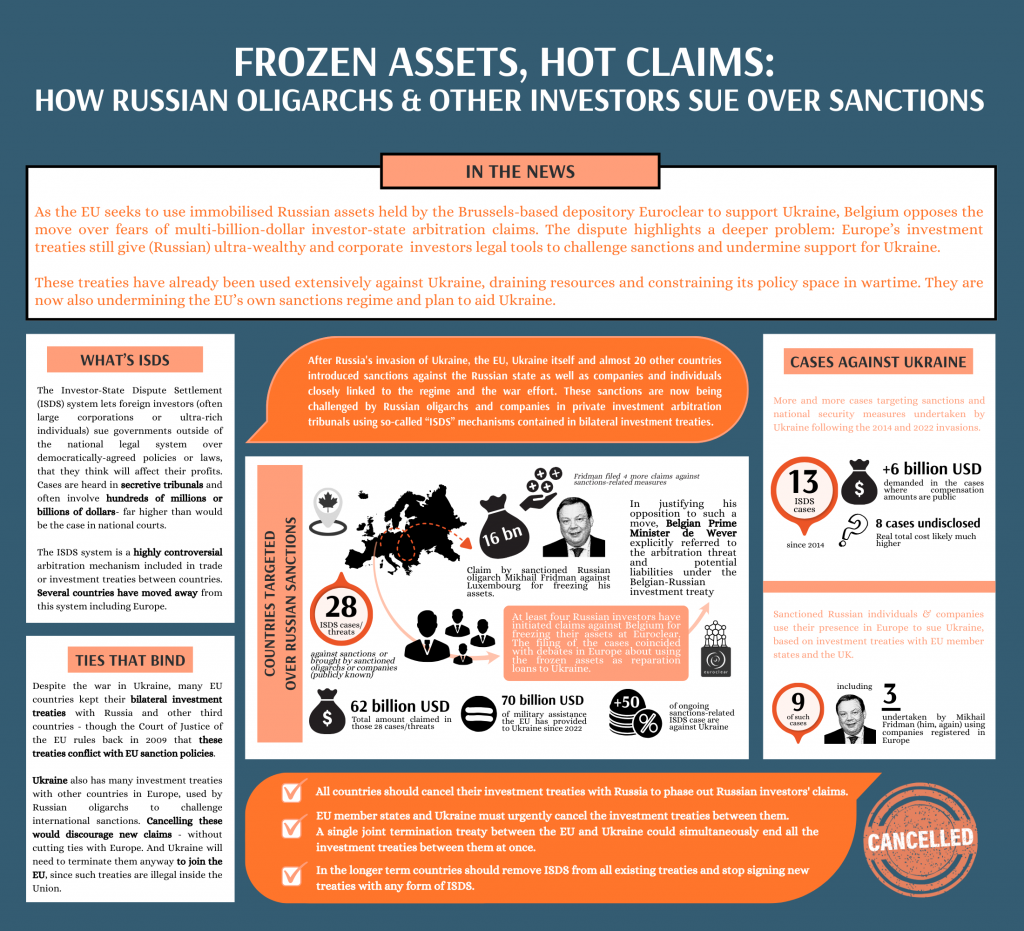
Belgian Prime Minister Bart de Wever’s refusal to use the immobilised Russian assets held at Euroclear for fear of arbitration claims exposes how investment treaties can constrain the EU at a critical moment. An analysis of publicly-disclosed claims conducted by civil society organisations reveals that 28 investment arbitration cases (including threats) have been initiated by sanctioned oligarchs or companies, most of them directly challenging sanctions against Russia, claiming total damages of 62 billion USD. It is almost equivalent to the military assistance budget the EU has provided to Ukraine since 2022.
More than half of the cases challenging sanctions have been filed in 2025 alone. This surge shows how investors increasingly resort to a little-known system called Investor State Dispute Settlement (ISDS) to sue states for billions over public-interest decisions, including the sanction policies adopted by Ukraine and its supporters.
Paul de Clerck, economic justice expert at Friends of the Earth Europe, commented:
“How is it possible that secret tribunals are used to challenge sanction measures that seek to stop Russia’s brutal war? If we want to prevent sanctioned oligarchs from dragging Europe, and even more so Ukraine, into billion-dollar disputes, these investment treaties with Russia and Ukraine have to go.”
More than half of the ongoing sanctions related cases target Ukraine’s national security measures taken following the 2014 and 2022 invasions. Russian oligarchs and companies are filing ISDS claims via their subsidiaries in European countries (including Belgium, Luxembourg, the UK, Germany, Austria, and the Netherlands) and their investment treaties with Ukraine.
Fabian Flues, adviser on trade and investment policy at PowerShift continued:
“European governments are desperately trying to keep Ukraine financially afloat. Yet they continue to let sanctioned oligarchs exploit their countries’ investment treaties to challenge Ukraine’s national securities policies with billion-dollar claims. The solution is simple: immediately terminate the agreements that allow these attacks on Ukraine.”
Despite the war in Ukraine, many EU countries kept their bilateral investment treaties with Russia and other third countries intact. This despite the fact that the Court of Justice of the EU ruled in 2009 that these treaties conflict with EU sanction policies.
Jean Blaylock, coordinator of the European Trade Justice Coalition said:
“Our analysis clearly shows that this secret tribunal system is used again and again as a weapon against states’ ability to act in the public interest, even on questions of war and peace. Countries should get rid of ISDS wherever it exists and stop signing new treaties with any form of it.”
Investor State Dispute Settlement is an arbitration mechanism included in investment treaties between countries. It lets foreign investors who consider themselves negatively affected by policy or legal changes sue governments outside of the national legal system, in secretive tribunals for amounts much higher than in national courts.
The analysis also includes an annex of cases with actors, countries, and amounts claimed; an analysis of the mechanisms as related to different territories; and recommendations to policy-makers.
Read also
10 stories of how the rich and powerful hijacked justice: cases showing how ISDS undermine Europe’s ability to protect national security interests, take tax measures, run climate and environmental policies and safeguard democratic decision-making.