

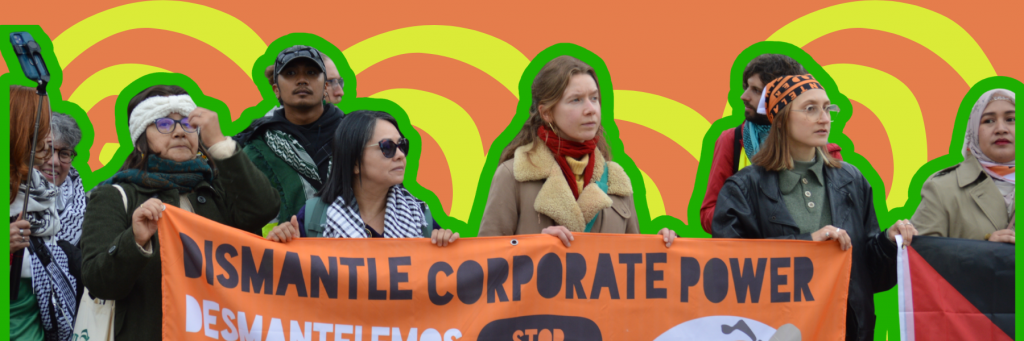
Ahead of this week’s intersessional consultations on the proposed UN Binding Treaty on business and human rights, Zakithi from Swaziland explains why we need to be able to hold transnational corporations accountable for the harms they cause to people and planet.
- As a member of the Rural Women’s Assembly, why do you think it is important to have an international treaty that regulates transnational corporations?
Transnational corporations (TNCs) often operate across borders with immense economic power, yet they remain largely unaccountable for the social and environmental harm they cause, especially in vulnerable communities. An international treaty would establish binding obligations that prioritize human rights over profit, ensuring that corporations cannot exploit weak governance structures in developing countries. For rural women in Southern Africa, such a treaty would be a critical tool to challenge land grabs, environmental degradation, and labor exploitation as given in the United Nation Declaration on the Rights of Peasants and other people living in Rural Areas (UNDROP). These issues disproportionately affect them due to systemic gender and economic inequalities.
Moreover, the treaty would amplify the voices of grassroots movements like the Rural Women’s Assembly (RWA), giving them a platform in global governance spaces. It would legitimize their demands for justice and provide mechanisms for redress when rights are violated. Without such a framework, rural women are left to confront powerful entities with limited resources and legal protections. A treaty would shift the balance, recognizing rural women not just as victims of corporate abuse, but as agents of change in shaping a more just and sustainable global economy.
- In what ways are transnational corporations violating human rights and the rights of rural women in Southern Africa, and particularly in Swaziland?
In Southern Africa, TNCs have been implicated in land dispossession, pollution of water sources, and exploitative labor practices often with the tacit approval of governments eager for foreign investment. In Swaziland, rural women have faced displacement due to large-scale agricultural and mining projects, which prioritize corporate profits over community wellbeing.
These projects frequently ignore land rights and fail to consult affected communities, violating both national laws and international human rights standards. An example in Swaziland is Maloma colliery Limited which have been blasting and people’s houses are cracking women can not farm because their crops turn black due to call dust we also have Bulembu asbestos who displaced people they do not have fields to farm and after finishing mining they left open holes and the asbestos still affect the community as it grows on hands and feet once in contact.
Additionally, corporate activities often degrade the environment, contaminating rivers and soil that rural women depend on for farming and daily survival. Women bear the brunt of these violations, as they are traditionally responsible for food production, water collection, and caregiving. The erosion of these resources undermines their autonomy and deepens cycles of poverty and marginalization. These abuses are not isolated incidents, they reflect a systemic pattern of corporate impunity that demands urgent intervention.
- How do these practices affect rural women in their daily lives — for example, in their access to land, water, and seeds?
When corporations seize land for commercial agriculture or extractive industries, rural women’s livelihoods are disrupted. Land is not just an economic asset it is a source of identity, culture, and survival. Without secure land rights, women are pushed into precarious labor or forced to migrate, disrupting families and community cohesion. The loss of communal land also erodes traditional farming practices and seed-saving knowledge, which are central to food sovereignty.
Water access is similarly compromised when industrial operations pollute or divert natural sources like the case of Zambia in the Copperbelt mine where they lose lives of both animals and humans. Women must travel longer distances to fetch clean water, exposing them to physical danger and reducing time for other productive activities. The introduction of genetically modified crops where corporations take rural women’s indigenous seeds to “improve” them further threatens biodiversity and women’s control over food systems. These practices create dependency on corporate inputs and undermine centuries of indigenous agricultural wisdom. In essence, corporate violation destabilizes the ecological and social systems that rural women have nurtured for generations.
- What role do you think the government of Swaziland, as well as other African governments, should play? And how are they acting in practice?
Governments in Southern Africa, including Swaziland, have a constitutional and moral duty to protect their citizens from corporate harm. They should enforce laws that safeguard land rights, environmental integrity, and labor protections especially for marginalized groups like rural women. This includes conducting transparent impact assessments, ensuring free, prior, and informed consent, and holding corporations accountable through legal and regulatory mechanisms. Governments must also invest in supporting rural women in indigenous seed multiplication and buy the inputs from them to provide a choice for farmers.
In practice, however, many governments prioritize foreign investment over human rights, often sidelining community concerns in favor of economic growth narratives. In Swaziland, the lack of political will and weak enforcement of land governance frameworks has allowed corporate abuses to persist. Corruption and elite capture further complicate accountability. While some governments have made commitments to gender equality and sustainable development, these are rarely translated into action on the ground.
- How are rural women organizing to resist corporate abuses and to build alternatives based on food sovereignty and peasant feminism?
Regardless of these violations Rural women are organizing boldly through movements like the Rural Women’s Assembly to resist corporate exploitation and reclaim their rights. They are engaging in grassroots mobilization, legal advocacy, and direct action to challenge land grabs and demand accountability. Through community dialogues, training workshops, and paralegal education, they are building collective power and legal literacy. These efforts are rooted in peasant feminism, which centers women’s knowledge, autonomy, and ecological stewardship.
At the same time, rural women are cultivating alternatives based on food sovereignty, reviving indigenous seeds through seed multiplication in all eleven-member countries, practicing agroecology, and creating cooperative economies. These models prioritize local control, biodiversity, and sustainability, offering a radical departure from corporate-driven agriculture by asserting their right to produce, distribute, and consume food on their own terms, rural women are not only resisting exploitation they are envisioning and enacting a future rooted in justice, care, and community resilience.
- Do you see this struggle as part of a broader internationalist solidarity among rural, feminist, and environmental movements around the world?
This struggle is deeply interconnected with global movements for feminist, environmental, and economic justice. Rural Women’s Assembly is part of a broader global campaign resisting corporate power and working with peasants’ movements like Lavia Campensina to demand climate justice and reparations. These alliances recognize that corporate exploitation is a global phenomenon, and that solidarity across borders is essential to dismantle it. International networks provide platforms for shared learning, advocacy, and coordinated action, amplifying local struggles on the world stage.
The vision of peasant feminism and food sovereignty resonates globally, challenging neoliberal models and proposing alternatives rooted in care, reciprocity, and ecological balance. As rural women build alliances with climate activists, indigenous communities, and feminist organizers, they are forging a powerful counter-narrative to corporate globalization.