
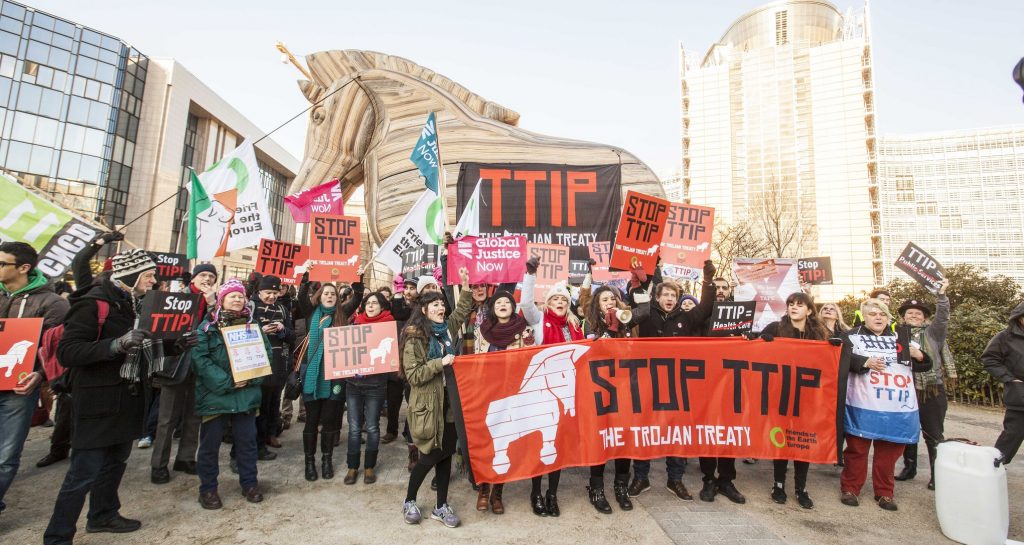
The ‘framework agreement’ on trade between the EU and the US that was published August 21 is a worrying reminiscence of the infamous TTIP -the Transatlantic Trade and Investment Partnership- of a decade ago.
That deal was never concluded, largely due to massive public mobilisation against the proposed agreement. Friends of the Earth groups and others loudly decried its undemocratic nature and the risks that the EU would be giving away key environmental, health, safety and other standards that had been established to protect citizens and the environment.
In the new framework agreement, the EU is giving away key standards and public interests that it was protecting 10 years ago.
We have decrypted some of the most pertinent and least publicly discussed sections:
- “The United States and the European Union commit to work together to reduce or eliminate non-tariff barriers“
This is a general commitment to get rid of environmental, safety, public health, food, social, human rights and any other public interest standards.
- “The EU commits to address not-tariff barriers affecting trade in food and agricultural products, including streamlining requirements for sanitary certificates for pork and dairy products“
This puts higher EU standards on beef, chicken and other food products at risk.
- “With respect to automobiles, the United States and the European Union intend to accept and provide mutual recognition to each other’s standards“ and “The United States and the European Union commit to facilitate conformity assessments to cover additional industrial sectors“
The first part means that US cars only have to comply with – sometimes – lower US safety standards instead of EU ones if they are exported to the EU. The second commitment means that also on other products lower US standards will apply on products exported to the EU.
- In relation to the Corporate Sustainable Due Diligence Directive the EU “proposes changes to the requirement for a harmonised civil liability regime for due diligence failures and to climate-transition-related obligations“
While the EU has already started this with Omnibus 1, cementing these steps into a trade agreement will make it almost impossible in the future to introduce a common civil liability regime and put climate reduction targets on companies in the EU.
- “The United States and the European Union will commit to negotiate a mutual recognition agreement on cybersecurity“
This will make it much harder for the EU to develop own standards for cybersecurity and expose citizens to lower US protection standards.
Julie Zalcman, trade expert at Friends of the Earth Europe concluded on the framework agreement:
“With this deal the EU is giving away vital environmental, health and safety protection for its citizens. European supermarkets will be flooded with US products that don’t comply with EU standards, like chlorinated chicken and hormone treated beef, creating unfair competition with EU farmers and putting citizens’ health at risk. The most gloomy part: If the EU accepts this ‘deal’, it ensures that US companies can’t be held accountable in court for the damage they cause on the environment and human rights.“