
This article was written by Boon Breyne in collaboration with Marilin Eessalu
2025 has been quite a year. Both the European Commission and many national governments have consistently moved power away from the people – but we do have good news. There is a blossoming movement for a radical and systemic shift away from the current social and economic rules, fired by a vision of degrowth. In the past months, Friends of the Earth attended the International Degrowth Conference in Oslo, the Hope in a Time of Collapse gathering in Lyon and the Estonia Beyond Growth conference in Aegviidu (among other national conferences). Read on for a brief overview on our key takeaways of these meetings and more.
Degrowth is about liberation
At the opening of the International Degrowth Conference in Oslo, Irene Velez-Torres, Director of the Colombian National Environmental Agency, took the stage and said it all:
“They take the gold and leave behind polluted rivers. They take the coal and leave behind craters and polluted air. Yet when rivers are polluted, as long as GDP goes up it’s called development. We resist this narrative in the current government!
What needs to grow? What needs to degrow? Growth for what, and growth for whom?
We choose life, not death. There can be no democracy without environmental justice. No peace without social redistribution. No future if we fail to act now. Let’s break the chains of dispossession.“
While degrowth as term is coined by European activists, we must see the movement as a part of a global struggle for liberation from imperialism. The Global North’s responsibility is undeniable. Historic movements resisting imperialism and texts such as the People’s Agreement of Cochabamba have long put on paper the core principles of an overextracting, overexploiting and overemitting North as opposed to an extracted, exploited and climate disrupted South. Degrowth is an invitation to assume our shared global history and an invitation to join their struggle.
Working time reduction will be globally just or it won’t work.
New Economies: Hope in a time of collapse was a global gathering in Lyon, France, bringing together 250 people committed to fundamentally transforming our economic system.
An important takeaway of the event was Julia Steinberger rephrasing what Pheko Lebohang Liepollo had already said in Oslo a couple of months before: the popular working time reduction policy proposal must be put in a global context of unequal exchange of labour.
Recent research by Jason Hickel, Morena Hanbury Lemos and Felix Barbour quantified how the wealth in the Global North is upheld by a massive net appropriation of labour from the South, through trade and supply chains. Even more striking is that for the same work of equal skill, wages are on average ten times lower in the South.
We must reduce the South’s dependency on the imperial core, reclaim economic sovereignty, cooperate for the collective abolition of debt and structural adjustment, and reorient production toward national development and human well-being.
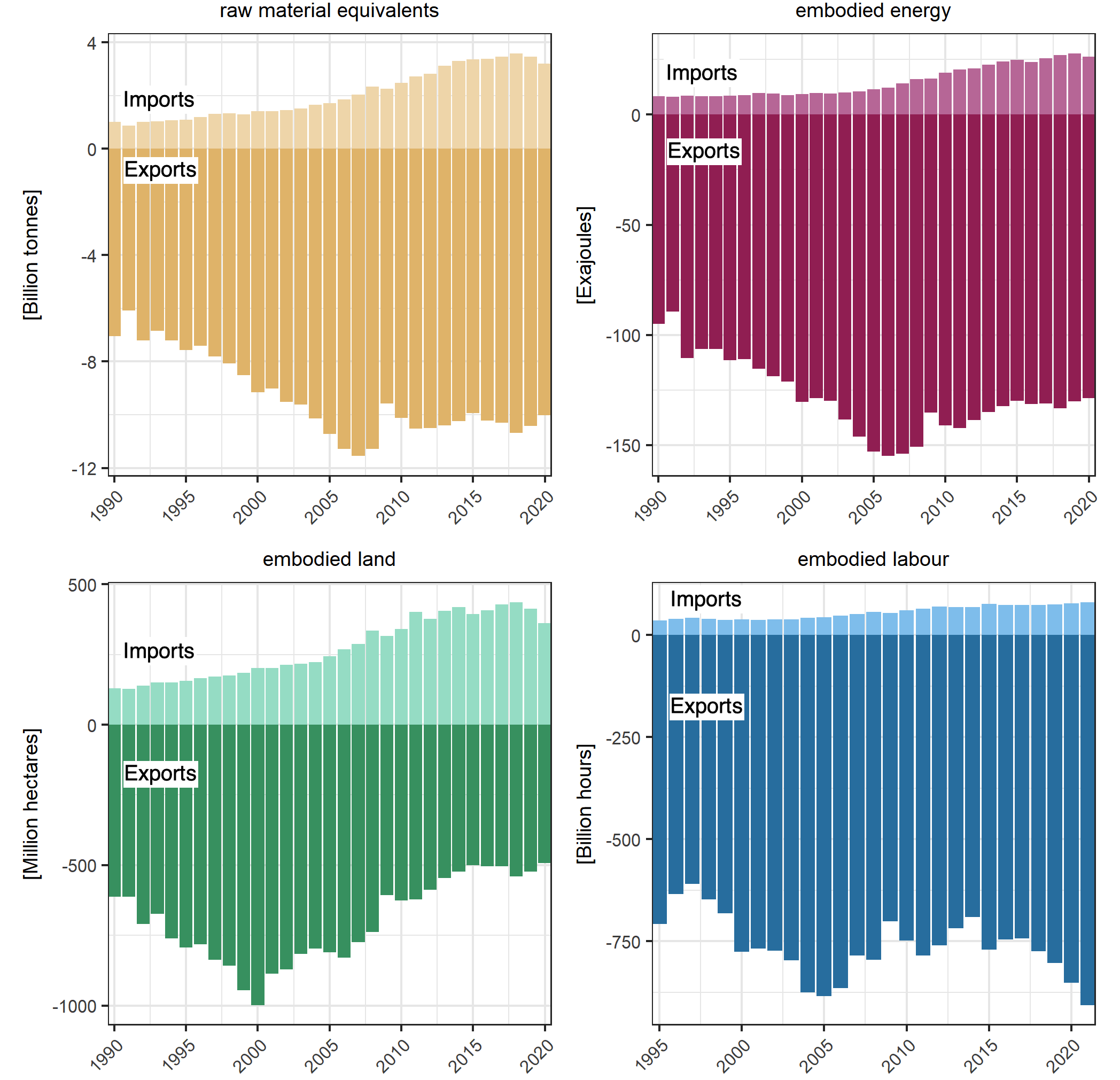
Title of the graphs: The South’s physical imports and exports
Image from: https://globalinequality.org/unequal-exchange/
Data from: Hickel, Hanbury Lemos & Barbour, Nature Communications (2024).
So it is now clear that when working time reductions are proposed as a means to redistribute work time more evenly in a shrinking economy, it is a vital tool yet working time reduction shall be globally just or it won’t work.
National conferences: building a movement outside of our bubbles
Besides the global gatherings, country-level conferences still popped up like mushrooms in 2025 in Norway, in Spain or in Estonia.
The Beyond Growth Estonia conference in October was the first major degrowth event to be organised in Estonia, as part of the international series of Beyond Growth conferences. The conference was organised by Degrowth Estonia and Biotoopia, in collaboration with partners from TalTech and Tallinn University. The Estonian Green Movement / Friends of the Earth Estonia was also present at the conference. These are their highlights.
The conference was two full days of packed panels and parallel discussions at a beautiful lakeside venue, bringing together policymakers, economists, scientists, journalists, members of the civil society and, what’s most important – newcomers to the concept of beyond growth. In an Eastern European country, talks about beyond growth economy tend to be met with instant opposition because of the associations to Soviet era communism. Many sessions addressed this challenge, as did several guests who arrived with this preconception – reminding us activists that it’s important to overcome the first negative reactions when meeting with people outside our bubble.
Altogether, it was an inspiring conference that set off ripple effects already, promising a broader discussion within Estonian society around the concept of beyond growth.