
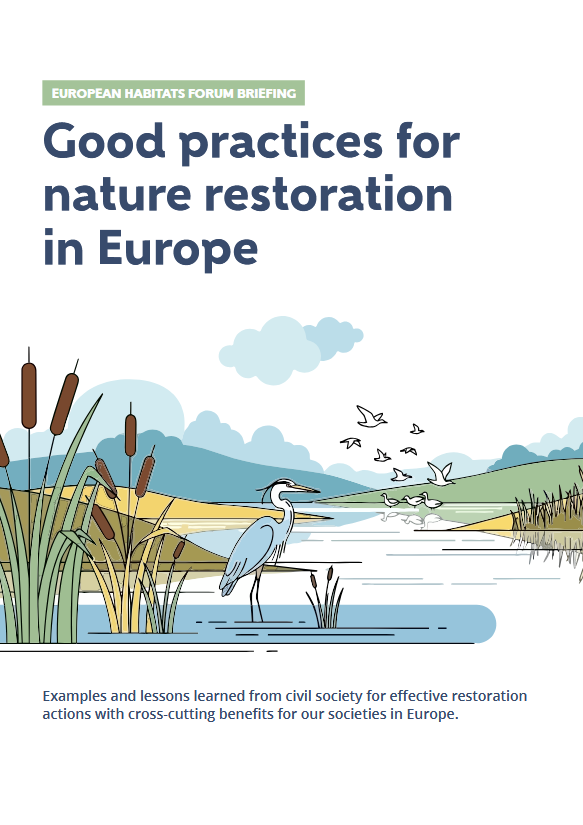
Examples and lessons learned from civil society for effective restoration actions with cross-cutting benefits for our societies in Europe.
The EU Nature Restoration Regulation marks a turning point for nature policy in Europe. For the first time, Member States have binding, time-bound obligations to restore degraded ecosystems across land and sea, with restoration measures to cover at least 20% of the EU’s land and marine areas by 2030 and all ecosystems in need of restoration by 2050.
The task ahead, although significant, does not start from zero. Across Europe, civil society organisations, land managers, local communities, public authorities and scientists have already developed and implemented practical approaches to restore rivers, peatlands, other wetlands, grasslands, forests, coastal habitats and other species-rich landscapes. Their experience shows that restoration is far from being an abstract policy ambition; it is rather an ongoing practical agenda already delivering many benefits for biodiversity and livelihoods, such as food, water security and climate resilience.
National Restoration Plans are the central tool for turning the Regulation into action. By September 2026, Member States must submit draft plans setting out where, how and with what resources restoration will be delivered. Recent civil society assessments show that preparation is underway in many countries, but progress remains uneven. The next phase is therefore critical to ensure that plans are science-based, inclusive, ambitious and practically implementable.
This implementation moment also sits within a wider European and global framework. It is essential to meet the EU’s biodiversity objectives, strengthening nature protection, and contributing to global commitments such as the Kunming-Montreal Global Biodiversity Framework and the UN Decade on Ecosystem Restoration. It also supports the EU’s broader resilience and preparedness agenda by helping reduce climate, water and land-use risks.
This briefing brings together examples from civil society and partners across Europe to show what effective restoration can look like in practice. The cases illustrate key ingredients for scaling up restoration: meaningful stakeholder engagement, clear ecological delivery, wider co-benefits, cost-effective approaches and visible results. The message is simple: nature restoration is necessary, feasible and already happening. The challenge now is to scale it up with the urgency, quality and cooperation that the ecological and climate crises require.