The European Commission presented today its long-awaited strategy for the future of livestock as part of a broader Vision for Agriculture and Food. At a time when mounting challenges in agriculture demand a transition towards a more resilient, small-scale farming that cares both for people and nature, the Commission’s proposal instead prioritises technofixes and expanding export markets for European products. Despite the ever-growing damage caused by industrial animal production – including water pollution, poor animal welfare, and devastating impacts of megafarms dominating rural – the Commission downplays the drivers of factory farming, and the sector’s major health, social and environmental impacts.
When animal factories take over small-scale farmers
From the almost 40% decline in farms between 2005 and 2020, it is mostly small-scale farms that disappeared. The majority of livestock farms are now highly concentrated and the average size of those that remain is getting bigger, as factory farms dominate the landscape in several European regions. These megafarms account for 72.2% of all the animals being reared in the EU. Most of them produce for or are linked to multinational corporations like Danish Crown, Vion Food Group, Groupe Bigard, Coren etc. In 2020, a small share of EU farms, the top 8% with the highest production, controlled 63% of all EU livestock and 36% of agricultural land.
By contrast, about two-thirds of farms, which had the lowest economic output, owned only 11% of livestock and 25% of the land.
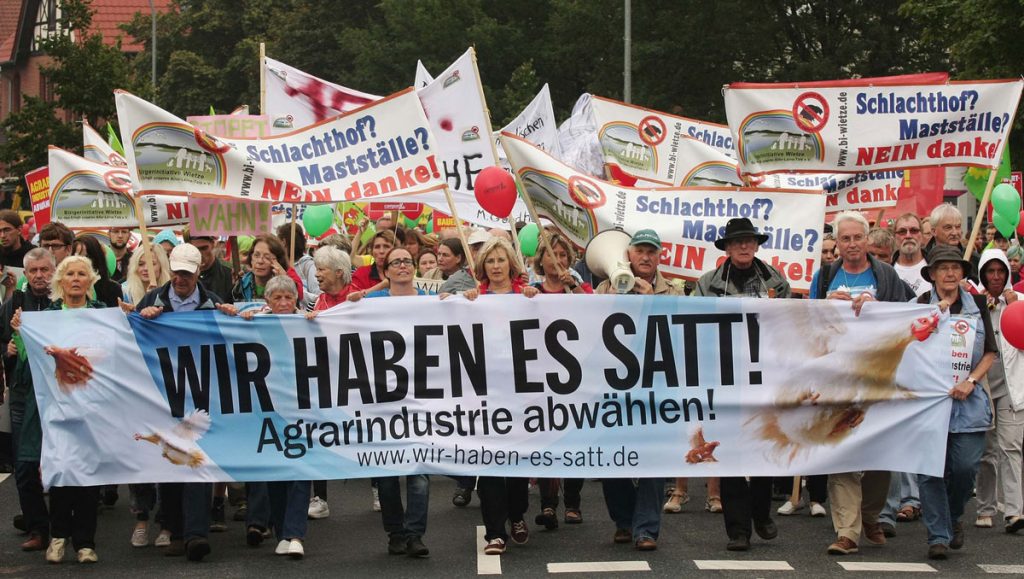
For Friends of the Earth Europe and the Stop Factory Farming Europe movement the solutions are clear – these industrial-scale operations should be treated as factories, like any other industrial sector, and subjected to strict rules to restrict their harm to nature, people’s health and animal welfare. And they should be differentiated from the producers putting animal welfare and health, the protection of natural resources and people’s health as part of their objectives.
Mathieu, dairy farmer in Vendée, France, has witnessed this corporate take-over.
“I have been farming for more than 15 years. Every year, we face growing challenges: climate change, volatile prices, increasing production costs and difficulties in securing a fair income for farmers. At the same time, the ongoing industrialisation of livestock farming is accelerating the disappearance of small and medium-sized farms, concentrating production in fewer hands and making it increasingly difficult for young people to enter the profession.”
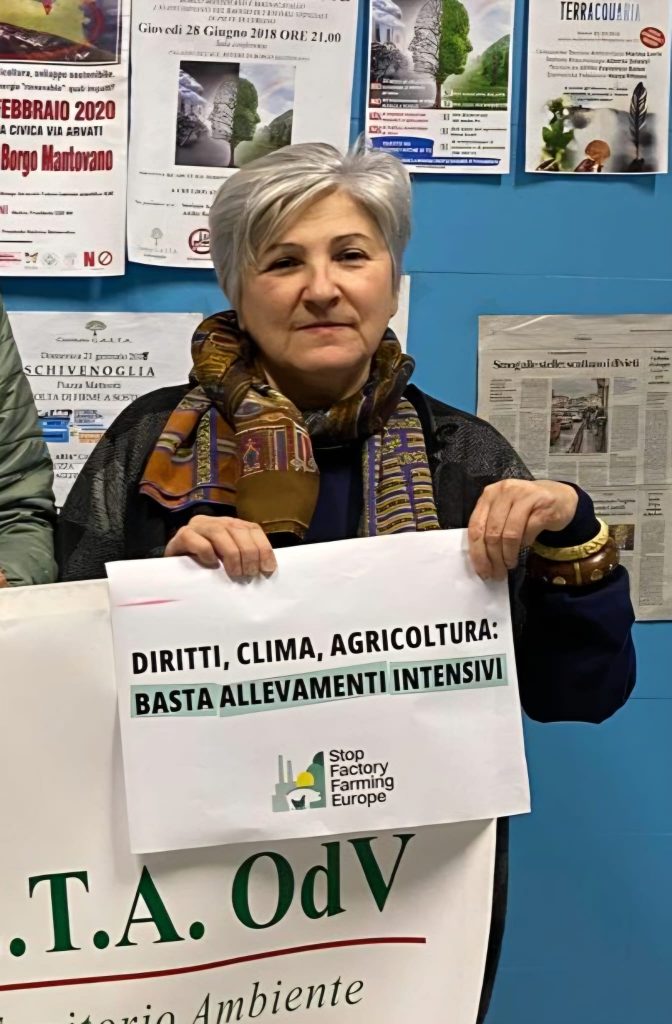
In the municipality of Schivenoglia (Mantua, Italy), an old pig farm from the 1960s, which was in the process of being decommissioned, was instead approved for renovation and expansion by Biopig, a company of the Cascone group. Following its reopening in October 2022, the operation’s authorised capacity more than doubled, increasing 1,973 to 4.107 pigs. The project was authorized without undergoing an Environmental Impact Assessment (EIA), even though the environmental and public health impacts of the original facility had never been evaluated and it is located less than 50 metres away from a residential area. The exemption was granted solely because the original farm predated 1988, when EIA legislation came into force.
Maura Cappi is a resident of Schivenoglia and President of the G.A.E.T.A. committee – a group of citizens and volunteers working to protect ecology, the local area and the environment. She says:
“While opposing the expansion project, as a committee and as citizens, we found ourselves alone in protecting our health and the environment. Not only did we have to face the company in the appeals we filed, but also our own Municipality and the Province of Mantua. A truly sad and worrying situation: we feel abandoned and attacked by those who should instead be protecting us.”
Toxic impacts on local communities
Evidence shows that animal factories pollute air, water and soil, compromise the well-being of animals, deteriorate human health and wildlife, and also contribute, in a very significant proportion, to greenhouse gas emissions and other pollutants. Communities across Europe are already facing these toxic impacts.
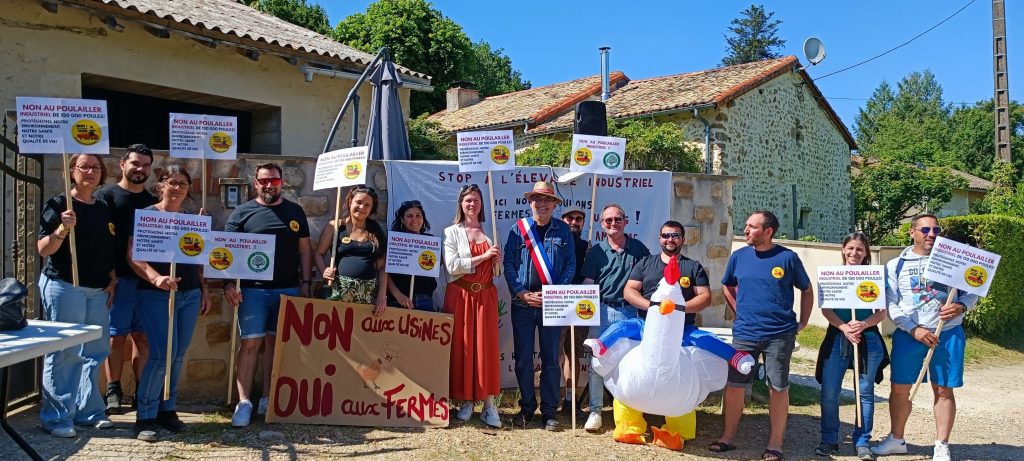
In Vaugeton, Nouvelle-Aquitaine (France), Félix, who lives next to an industrial poultry operation, recounts:
“Our lives have changed with the arrival of a factory farm housing 150,000 laying hens. From the outset, local residents and the local council voiced their opposition. We knew that the scale of the project was out of proportion to our local area and our living environment.”
Over the years, Nouvelle-Aquitaine has become a testing ground and launchpad for strategies to industrialise agriculture, particularly in the livestock sector. The impacts of industrialisation are particularly severe: soil, water and air pollution; the loss of biodiversity; a major contribution to climate change; and risks to our health. Rural depopulation has disrupted the social fabric and caused environmental damage.
Gathering at Vaugeton – 17 May 2025 (c) Non à la ferme usine de Vaugeton
Félix continues:
“Noise has become our main problem. The fans run day and night. We hear a constant humming noise, 24 hours a day, which intensifies in the evening and during hot spells. It never stops. Today, we feel that our quality of life has been sacrificed.
We are not opposed to farming. On the contrary. We would have preferred a farm on a human scale, one that fosters links with the local area, respects both animals and residents, with free-range hens and local production.”
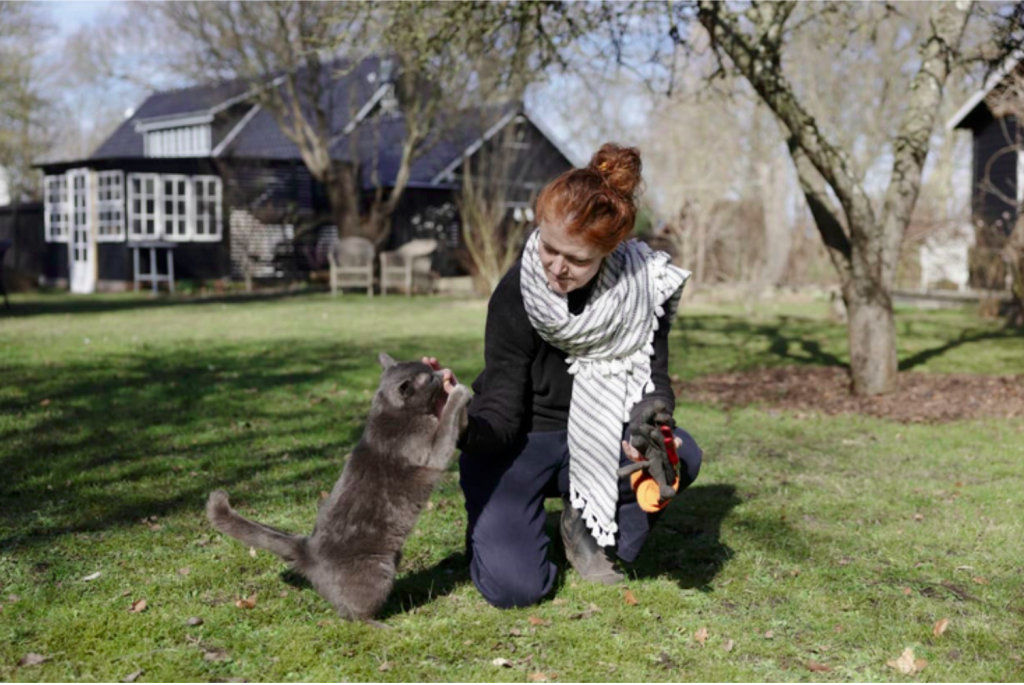
A sentiment echoed by Ziff Hansen, who lives in a small village in mid-Zealand, Denmark:
“I think it is a bit absurd that industrial agriculture gets subsidised while they destroy our waters, our nature and our environment. I think you should rather reward those farmers with smaller farms where the animal welfare is top class. Instead, we pour billions into an industry which is such a nuisance to so many.”
Throughout her life, Ziff has seen the countryside where she grew up changed dramatically. From a varied landscape with smaller farms, her childhood home has now turned into an industrialised site with animal factories and vast monocultures.
When local communities fight back
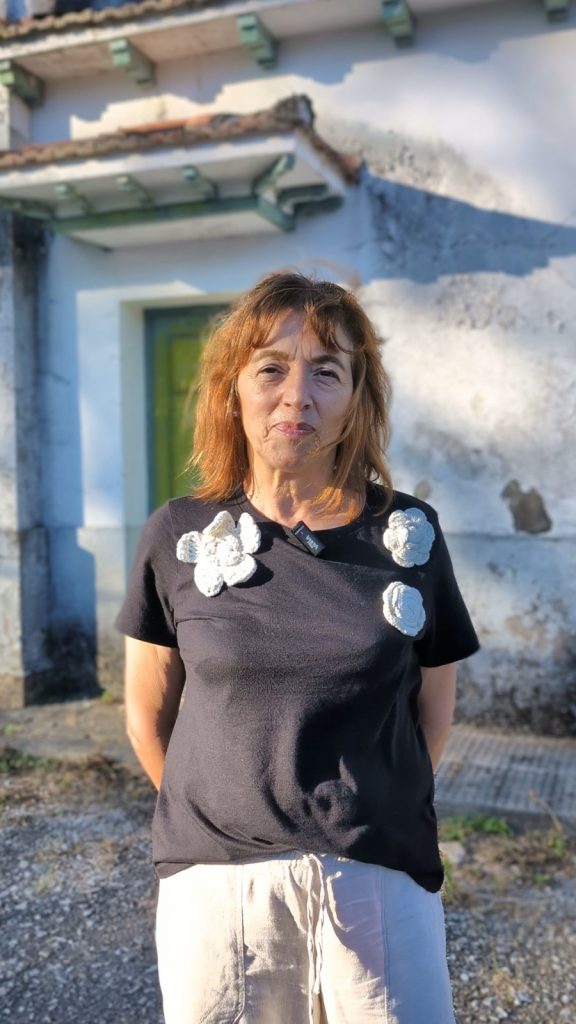
On the other side of the continent, in Spain, Merche Álvarez tells a similar story. She lives next to the As Conchas reservoir in Galicia. For more than a decade, the reservoir and surrounding environment have been polluted by hundreds of industrial livestock farms, while authorities failed to take action.
“All my childhood memories are linked to the reservoir. It was a natural paradise. I can’t figure out my life without it. My children learnt how to swim here. All our lives go around the reservoir. But now since it was polluted more than a decade ago, we can’t live here, we can’t open the windows, we are always afraid of breathing because of any risk for our health. But we are not leaving”, she says.
The water contains cyanobacteria, nitrates and antibiotic-resistant bacteria which could cause cancer and other serious health problems. As a result, Amigas de la Tierra / Friends of the Earth Spain, CECU and ClientEarth have been supporting the neighbours in taking authorities to court. One year ago, civil society won the case. For the first time a court ruled that authorities must protect human rights from the impacts of industrial livestock pollution.
Merche is one of the claimants in the case.
“Our authorities failed to take action against industrial livestock pollution, but they are the ones which should protect us. So, we took them to court and we won. We will not stop fighting until our rights are fully restored.”
A message to the EU
Felix shared:
“Our experience shows that factory farms have very real consequences for people living nearby. Behind the figures and administrative approvals, there are families, residents and villages who suffer the long-term effects of these projects.
At a time when the European Union is considering the future of livestock farming, we call for the voices of local residents to be heard.”
Mathieu concludes:
“The EU Livestock Strategy must support farmers who work with nature, strengthen local food autonomy, reward environmental and social benefits, and ensure that livestock production remains rooted in territories. Europe needs more livestock farmers, not animal factories!”
Friends of the Earth Europe is coordinating a European community of resistance against a toxic agribusiness-sponsored factory farm system. For more information about the campaign’s demands, partners, news and how to get active, visit stopfactoryfarming.eu