
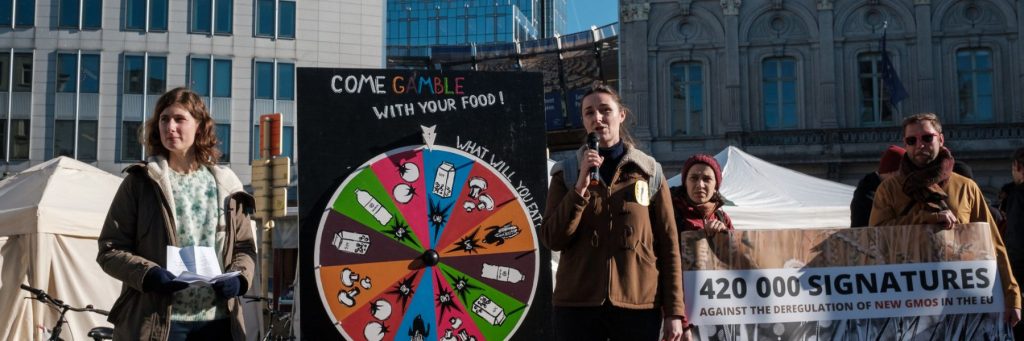
In December 2025, the three EU institutions agreed on a plan to remove key safeguards for the new generation of GMOs, so called new genomic techniques. As a result, the vast majority of them will now be allowed onto the market without any safety checks, transparency and liability requirements. If widely cultivated across Europe, this scrapping of protections will further entrench the breeding and farming sectors’ dependence on a handful of Biotech corporations.
Following outcomes of the trilogue negotiations, Friends of the Earth Europeassessesof the impacts of a far–reaching deregulation on nature, farmers, consumers, and the wider food sector:
Under the agreement, most new GMOs fall under a loosely defined Category 1, which will be excluded from EU GMO legislation, food and liability laws. The definition of what constitutes a ‘new GMO’ remains vague, creating significant regulatory loopholes.
Safety checks abolished for Category 1
All three EU institutions agreed to abolish safety checks for Category 1 new GMOs. This means these organisms can be grown and marketed without any prior safety checks or pre-marketed authorization requirements. The removal of these basic safety requirements undermines the precautionary principle that underpins EU food and environmental law.
Labelling limited to seeds only
The EU Commission and agriculture ministers pushed for labelling requirements to apply only at the seed level. During the trilogue, the European Parliament’s negotiator failed to defend the Parliament’s position calling for labelling throughout the entire food chain, from seed to final product.
This means only seeds will be labelled. Neighbouring farms, food processors, supermarkets and consumers will be kept in the dark about contamination threats or whether products contains new GMOs. They will be unable to take preventive measures or make informed choices about what they grow, sell or eat.
Traceability abolished
A core principle of EU food law is traceability: each operator must inform the next about a product’s quality, characteristics and ingredients. Until now, this rule has applied to all GMOs. The EU Commission and Council demanded to exclude new GMOs from this rule, while the European Parliament at least wanted to ensure process-based traceability.
The trilogue outcome dismantles traceability altogether. This will make it harder for farmers to defend themselves against false claims that they are growing patented GMO crops, increasing their legal and financial vulnerability.
Some plants excluded from category 1
The agreement introduces a so-called ‘negative list’. New GMOs that are designed to survive spraying with weed killers or to produce toxins to harm plants pests will be excluded from category 1 and will remain regulated as category 2 new GMOs.
At this stage, no calculations can be made to assess how many new GMOs currently in development will fall then under this category 2. Publicly available information shows that, in non-EU countries, only a very limited number of new GMOs are actually grown on large scale.
Flood of patented seeds expected
So far, patented seeds have played a limited role in Europe’s breeding and farming sectors. This is set to change with the development of new GMOs, which are all patented. Deregulation will therefore further strengthen corporate control over farmers and breeders.
The European Commission’s draft proposal failed to address patent concerns. Agriculture ministers opted for a voluntary license agreement – non-binding and ineffective. The European Parliament amended the proposal, specifying that new GMOs – including plants, plant material, genetic information and associated process – should not be patentable. However, during the trilogue, Parliament’s negotiator abandoned this position.
It means that breeders will be forced into lengthy negotiations with a handful of biotech corporations to keep their right to work with genetic material, whether developed through conventional breeding or gene-editing. This will hinder the development of plant varieties that can cope with extreme weather conditions, new pests, and diseases, especially in a situation in which often patent claims are so broad that even organic bred plants can fall under such claims.
Farmers are left alone facing legal uncertainty in a system where both plant materials and breeding processes may be patented.
A minority of new GMOs remain regulated
Only a small percentage of new GMOs will be regulated as category 2, where basic rules on labelling, traceability and safety checks still apply.
Next steps
On 19 December, EU diplomats from the Committee of Permanent Representatives (Coreper) endorsed the trilogue outcome ahead. Only Austria, Belgium, Bulgaria, Croatia, Germany, Hungary, Romania, Slovakia and Slovenia did not signal support. A Council meeting in early 2026 is expected to formally adopt the agreement on behalf of agriculture ministers.
In the EU Parliament, the trilogue outcome still requires formal adoption in plenary, likely in February or March 2026