
Next week will mark the start of the 11th session of negotiations for a United Nations Binding Treaty on transnational corporations and human rights, a process that seeks to close legal loopholes that allow these corporations like TotalEnergies, Exxon Mobil and Siemens to systematically violate human rights, mainly in the Global South, without consequence and with total impunity.
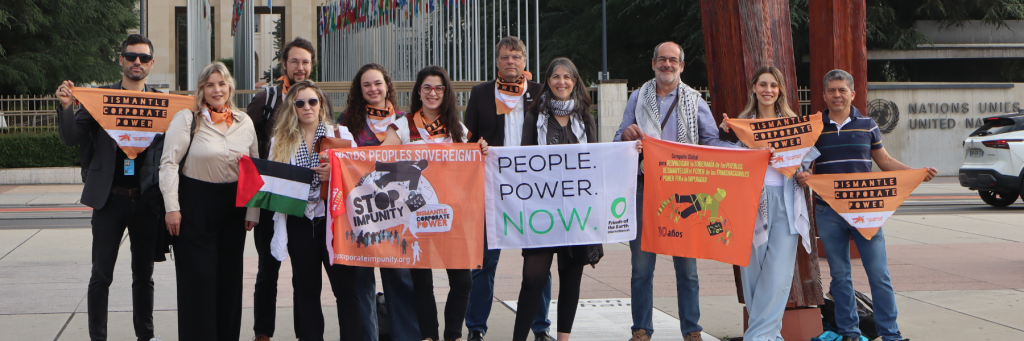
With the radical rollback of social and environmental laws in the European Union, brought forward by heavy industry lobbying, on the one hand, there is the UN Binding Treaty process on the other, which brings light to these times of corporate impunity. It is the struggle of peoples who, from their territories, travel each year to Geneva to defend their sovereignty and demand a binding treaty capable of dismantling this architecture of impunity.
These struggles do not originate in offices but in communities resisting dispossession and the destruction of their lands. Alongside social movements from across the world, these communities place their hopes in the Binding Treaty as an essential tool to curb corporate power and open pathways toward global justice. While governments of the Global North continue to bet on an extractivist and neocolonial model, peoples of the South are advancing legal corporate accountability frameworks that inspire the entire world — as seen in Brazil, Colombia, and beyond.
But corporate impunity also rears its head in Europe. The same corporations and banks that exploit the Global South are evicting neighbours, defrauding the elderly, and profiting from multimillion-euro projects while public services deteriorate and exorbitant sums are diverted to the arms industry, in countries across Europe.
Their impact reaches rural workers and depopulated communities, leaving deep environmental and social scars. From the attempt to reopen the Aznalcóllar mine in Andalusia (Spain), the site of one of the country’s worst ecological disasters, to manganese mining in Chiatura, Georgia, where entire communities are forced to live amid pollution and collapsing ground. These situations exemplify how transnational corporations also wreak havoc in Europe, and that corporate impunity is a global phenomenon. So, the resistance must be global as well.
But this treaty is also a matter of internationalist solidarity. The standard of living in Northern countries is often sustained by the systematic exploitation of communities in the South. A clear example is the coal extraction at the Cerrejón mine in Colombia, operated by Glencore, a Swiss multinational. While indigenous and Afro-descendant communities in La Guajira endure decades of displacement, water scarcity, and pollution, the coal extracted from their lands is shipped to countries in the Global North to power their industries and homes.
Similarly, the LNG gas megaproject in Cabo Delgado, Mozambique, led by the French transnational corporation TotalEnergies, has brought militarisation, human rights violations, and the destruction of coastal livelihoods — all to secure energy supplies for the Global North.
In contrast, the EU continues to move forward with free trade agreements such as EU-Mercosur, maintains diplomatic relations with the genocidal State of Israel, and ensures corporations can continue their imperialist and neocolonial offensive by removing obstacles in their way, like social and environmental laws, instead of responding to the demands of communities and peoples around the world, the EU chooses to deepen inequalities so that a few can keep filling their pockets at the expense of the working class.
But global hope in this treaty persists and internationalist solidarity is growing as an unstoppable force against corporate impunity. This is why we should all keep our eyes on the UN Binding Treaty!